Equity matters for academic performance in online learning: The roles of motivational beliefs and prior experienc
Abstract
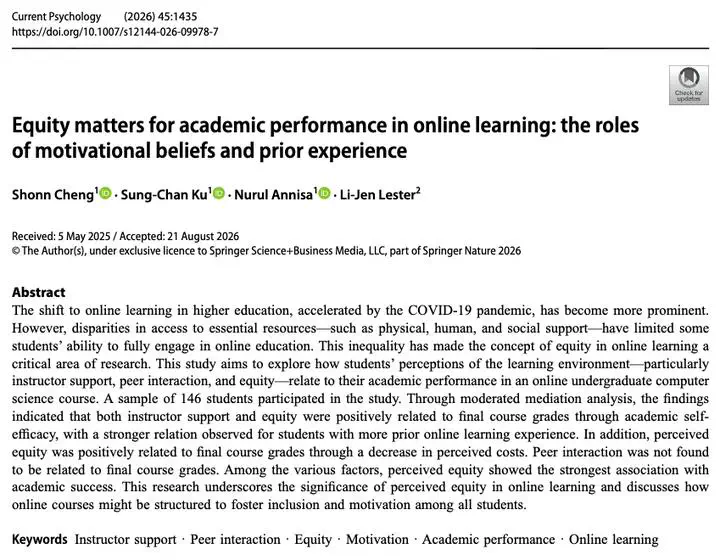
The shift to online learning in higher education, accelerated by the COVID-19 pandemic, has become more prominent. However, disparities in access to essential resources—such as physical, human, and social support—have limited some students’ ability to fully engage in online education. This inequality has made the concept of equity in online learning a critical area of research. This study aims to explore how students’ perceptions of the learning environment—particularly instructor support, peer interaction, and equity—relate to their academic performance in an online undergraduate computer science course. A sample of 146 students participated in the study. Through moderated mediation analysis, the findings indicated that both instructor support and equity were positively related to final course grades through academic selfefficacy, with a stronger relation observed for students with more prior online learning experience. In addition, perceived equity was positively related to final course grades through a decrease in perceived costs. Peer interaction was not found to be related to final course grades. Among the various factors, perceived equity showed the strongest association with academic success. This research underscores the significance of perceived equity in online learning and discusses how online courses might be structured to foster inclusion and motivation among all students.

Shonn Cheng
Assistant Professor
I specialize in developing and applying advanced organizational research methods, particularly focusing on the statistical and practical challenges of complex survey data analysis.